Click logo for Home Page"
T-Tail-Tall-Tail:
TAIL OF THE STORM
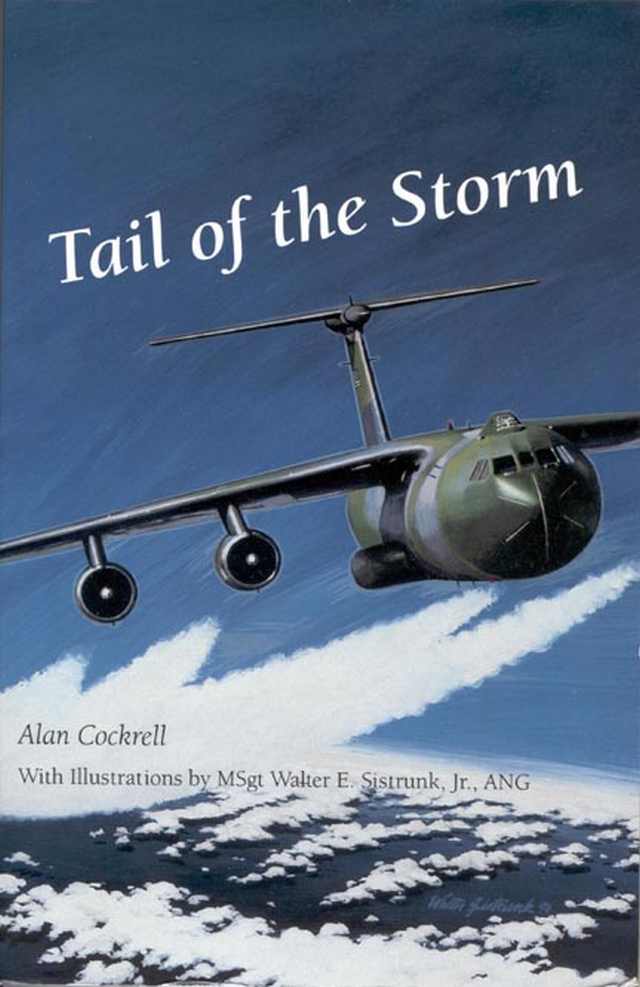
Alan
Cockrell wrote a book about
his C-141 experiences. It's worth locating if you
are a real C-141 junkie.
Link to Alan's
web page.
for more about this book.
Here's a review by Kevin Rhoades:
Tail of the Storm by Alan Cockrell.
The University of Alabama Press
Box 870380
Tuscaloosa
Alabama 35487-0380
1995, 234 pages, $24.95.
When Saddam Hussein's army invaded Kuwait in August
1990, precipitating US
intervention to free the Arab emirate, few people in
national policy-making
positions could accurately envision the complexity
of fighting a war
seventy-five hundred miles from American soil. In
particular, the difficulty of
supplying war fighters in-theater was probably
imperceptible to most people.
But the logistics tail from the United States to
Saudi Arabia--the point of
embarkation for most military operations during the
war--moved millions of tons
of equipment, supplies, and personnel; represented
one of the most crucial
aspects of the conflict; and eventually provided US
forces with the tools for
victory.
Alan Cockrell, a command pilot who logged almost one
thousand hours as an
aircraft commander during Operations Desert Shield
and Desert Storm, uses the
logistical "tail of the storm" as a framework for
chronicling his keen
affection for flying and airplanes in this very
readable, humorous, and
insightful view of military transport aviation
during a time of national
crisis. He accurately captures the balance of
purpose shared by most military
aviators: a broad sense of duty to country and a
more selfish passion to slip
"the surly bonds of earth" for personal
satisfaction.
Cockrell punctuates his work with personal stories
encompassing his 20-plus
years as a pilot in which he flew private aircraft,
tactical fighters, and
heavy transport aircraft for himself, the Air Force,
the Air National Guard,
and a commercial airline. These poignant vignettes
from the cockpit and
military facilities around the world expose the
human aspect of military
aviation. In one episode, Cockrell brings life to
the complex emotional and
logistical demands of a trans-global C-141 mission
from the United States to the
Kuwaiti theater. He illuminates the fraternal
spirit, crew members' practical
jokes, inefficiencies and inconveniences endured,
humorous and terrifying
experiences in the cockpit, as well as commentary on
current issues such as
female pilots in the Air Force. Also revealed are
the personal consequences
paid by airmen who pursue their dreams, such as
displacement from family, jet
lag, never ending "bag drags," and, occasionally,
the death of a comrade.
Perhaps the most engaging aspect of the book is the
way Cockrell consistently
praises the professionalism and talent of the men
and women--both enlisteds and
officers, fliers and non-fliers--with whom he flew.
The book is filled with
nuances of the teamwork and family that motivate
everyone to endure--even in
the face of danger or, worse, boredom and stupidity.
Cockrell shares personal stories of how misguided
fervor in the cockpit can
quickly translate into death for an unwise or
unsuspecting pilot. He recounts
how he tried to prove his tenacity to the wing
director of operations by
attacking a practice target at high speed, low
altitude, and with great bravado
but without proper planning and target acquisition.
The result was near death
in a fiery crash of his A-7 as his wingman looked
on. Another story involves a
genre of frustration that all crew members endure on
long missions. In this
case, the commanding general learned that hotel
rooms at Torrejon Air Base,
Spain, were reserved for Air Force Academy cadets,
while visiting aircrews had
to sleep in the base gymnasium. According to
Cockrell, the general "proceeded
to clean out the temple." These and other examples
highlight the illogic that
seems to haunt all large bureaucracies.
Cockrell grabs the logistical tail and parlays it
into an entertaining and
realistic account of the magnitude and limitations
of supplying a distant war.
As a bonus, it is also an agreeable, personal memoir
that merits reading by
fellow aviators and aviation enthusiasts alike,
because it provides a vivid and
coherent account of the trials and tribulations of
those people who flew in the
Tail of the Storm.
Capt Kevin M. Rhoades,USAF
Colorado Springs, Colorado